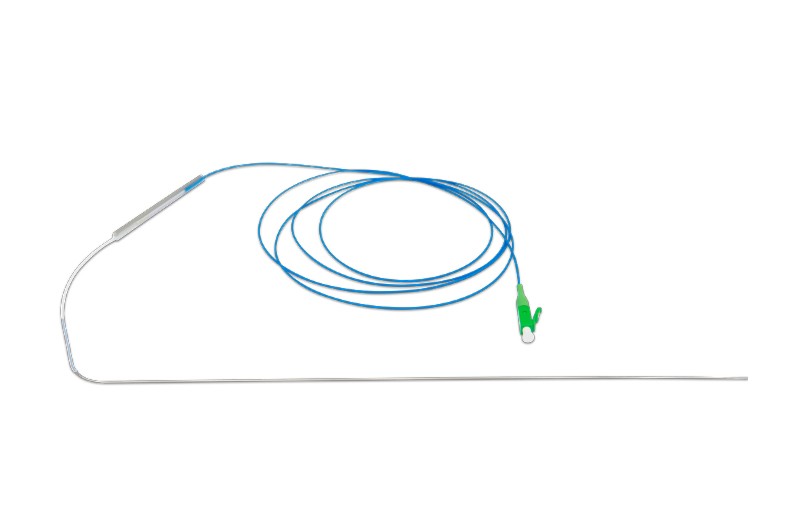
Fiber Bragg Grating (FBG) Optical Sensors

Fiber Optic Sensors

Fiber Bragg Grating (FBG) optical sensors are cutting-edge devices that utilize the principles of light reflection within optical fibers to provide highly accurate and reliable measurements.

They are widely used in industries where precision, durability, and real-time monitoring are critical.

How FBG Sensors Work

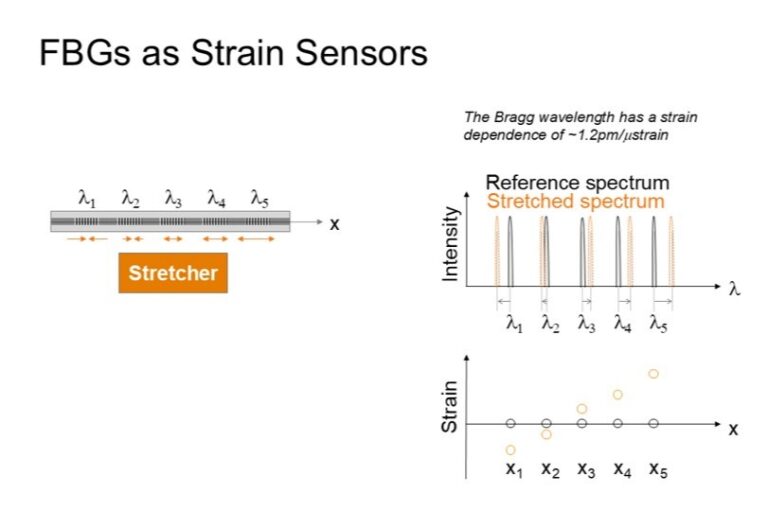
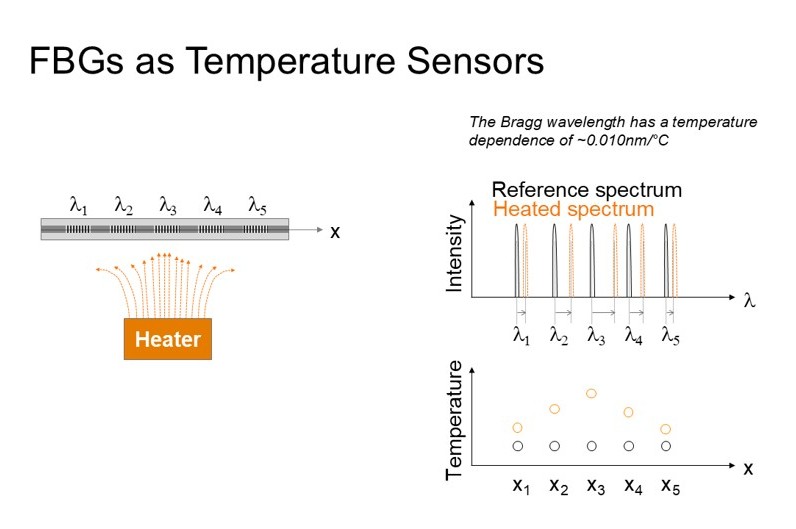
FBG sensors operate by embedding a grating within an optical fiber that reflects specific wavelengths of light. When external conditions such as strain or temperature change, the reflected wavelength shifts.

This shift is measured and converted into precise data, enabling accurate monitoring of various parameters.

Parameters FBG Sensors Can Measure

FBG sensors are versatile and can sense multiple physical parameters, including:

  • Strain – Detects structural deformation or stress.
  • Temperature – Measures thermal variations with high precision.
  • Pressure – Monitors pressure changes in industrial systems.
  • Vibration – Captures dynamic movements and oscillations.
  • Displacement – Tracks positional changes in structures or machinery.

Advantages of FBG Sensors

Fiber Bragg Grating or FBG technology offers several benefits over traditional sensing methods:

  • High Accuracy and Sensitivity – Delivers precise measurements even in harsh environments.
  • Electromagnetic Immunity – Unaffected by electromagnetic interference, ensuring stable performance.
  • Multiplexing Capability – Multiple sensors can be installed along a single fiber, reducing complexity and cost.
  • Durability and Longevity – Robust fiber construction with no moving parts makes them ideal for long-term monitoring.
  • Compact and Lightweight – Perfect for applications where space and weight are critical.

Applications of FBG Sensors

Fiber Bragg Grating (FBG) sensors are transforming monitoring and control across various sectors:

  • Aerospace – Monitoring of aircraft structural health and critical systems.
  • Civil Engineering – Bridge, tunnel, and building integrity assessment.
  • Energy – Power grid and pipeline monitoring.
  • Cryogenic – Liquified gas production monitoring and safety surveillance.
  • Healthcare – Medical devices and patient monitoring systems.
  • Industrial Automation – Machinery and process control and optimisation.

Why Choose FBG Sensors from Proximion?

Proximion has extensive experience in the deployment of FBG optical sensor systems in industrial and critical environments.

Our key competence is to understand the application requirements to design, manufacture and deploy solutions specific to the customer’s need.

Such solutions provide real-time, accurate data for smarter decision-making, improved safety, and optimized performance. Their adaptability and reliability make them the preferred choice for modern sensing solutions for today’s demands to optimise efficiency, enhance sustainability and increase safety.

From Optical Sensors to Complete Fiber Optic Sensor Systems

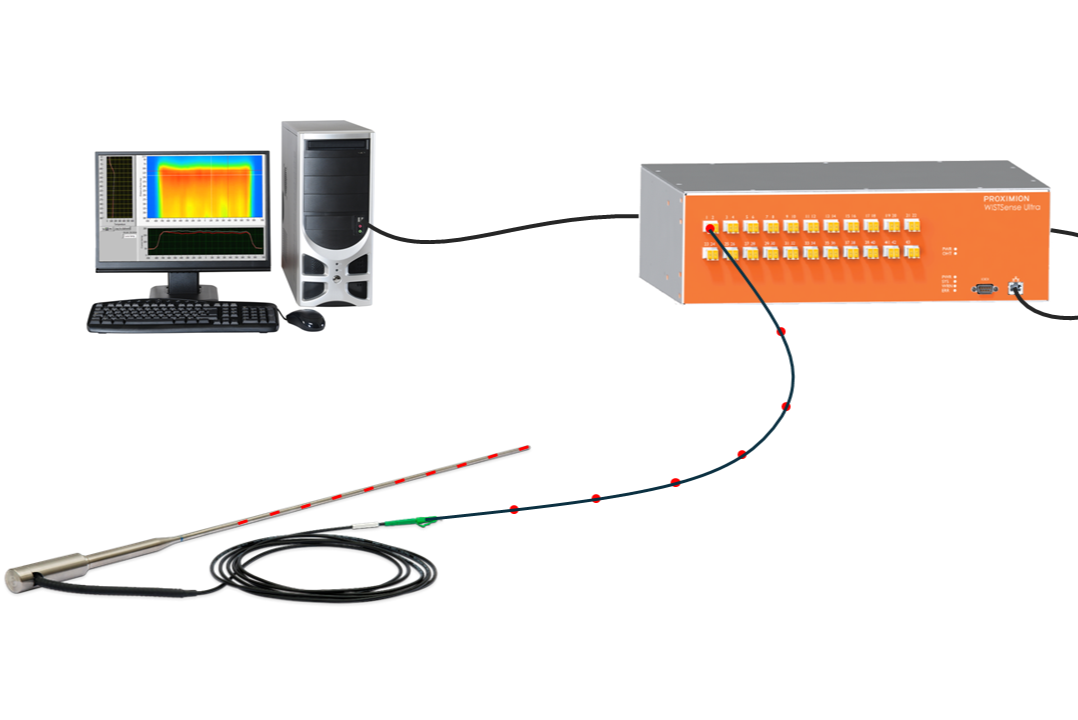
An optical sensor is most valuable when designed as part of a complete measurement chain. In an FBG-based system, the sensing element, optical fiber, interrogator, calibration method and software must work together. Each Fiber Bragg Grating reflects a defined wavelength, and an external change shifts that wavelength. An interrogator identifies the shift, while calibration translates it into temperature, strain, pressure, vibration or another engineering parameter. By placing gratings with different reflection wavelengths along one fiber, fiber optic sensor systems can provide many measurement points through a single optical connection.

From Optical Sensors to Complete Fiber Optic Sensor Systems
Engineering the Measurement, Not Just the Grating

Engineering the Measurement, Not Just the Grating

The performance of fiber optic sensors depends on how effectively the physical condition is transferred to the FBG. Packaging may be designed to couple strain, conduct heat, respond to pressure or isolate the grating from unwanted influences. Fiber routing, connector quality, interrogator resolution, sampling speed and compensation for cross-sensitivity can also affect accuracy and stability. Successful fiber optic sensing therefore requires application knowledge as well as optical-component expertise.

Proximion approaches each project as a system-engineering challenge. Measurement range, response time, installation method, operating environment and data interface are considered together. The resulting fiber optic sensor system can connect to PLC, SCADA or other monitoring and control platforms, turning wavelength data into information for process control, condition monitoring, predictive maintenance and safety management.

Why Fiber Optic Sensing Works in Demanding Environments

FBG-based optical sensors are passive at the measurement point and immune to electromagnetic interference. They can operate close to high-voltage equipment, powerful electrical machinery and radio-frequency systems without the signal disturbance that can affect electronic sensors. Their small size and low mass also support installation in restricted spaces or integration into structures and composite materials.

Multiplexing is another important advantage. Multiple FBGs can share one fiber and be read by a remotely located interrogator, reducing cabling and enabling multipoint optical monitoring over long distances. With suitable design and packaging, systems can be adapted for industrial processes, energy infrastructure, aerospace platforms, civil structures and cryogenic environments.

Why Fiber Optic Sensing Works in Demanding Environments
Optical Monitoring and Optical Dispersion Compensation

Optical Monitoring and Optical Dispersion Compensation

Proximion’s expertise extends beyond measuring physical conditions. The same ability to control wavelength-selective reflection within fiber is used to manage optical signals. In a chirped FBG, different wavelengths are reflected at different positions, creating engineered time delays. This principle supports FBG-based optical dispersion compensation, where chromatic dispersion is counteracted to preserve the timing and shape of signals travelling through optical networks.

Proximion also develops optical monitoring solutions for communications links. Optical layer monitors can evaluate optical power, wavelength drift, optical signal-to-noise ratio and spectral shape, helping operators identify deterioration before it causes visible transmission errors. Together, fiber optic sensing, optical monitoring and dispersion management demonstrate a broad capability to extract information from light and control how light behaves.

In-House FBG Manufacturing and System Expertise

Proximion designs and manufactures its FBG-based products in-house using proprietary ultraviolet inscription technology, a two-beam interferometer and highly accurate motion control. The process enables the grating period and optical response to be tailored for sensing, filtering and dispersion applications. Combined with optical modelling, sensor packaging, interrogation, calibration and validation, this capability allows Proximion to develop custom solutions from initial specification through deployment. It positions the company as a leading expert in optical sensors and advanced fiber-optic systems for industrial, telecommunications and scientific applications.

In-House FBG Manufacturing and System Expertise